
.jpg)
Vibrant ceramic panels catching natural light in a double-height lobby. Monumental sculptural forms standing quietly in a civic plaza. Rotating exhibitions lining the walls of a jury assembly space.
When art is thoughtfully integrated into a courthouse, the building feels different right away.
As both an architectural consultant and an artist, I notice these moments instinctively. During courthouse assessment visits, I am always struck by a public lobby featuring a bold installation or a historical gallery thoughtfully presenting the story of the building and its community. These elements shift the atmosphere. What might otherwise feel procedural or intimidating becomes layered, human, and civic.
At a recent courthouse I visited shown above, Betty Woodman’s River View introduces color and movement into the public space, creating a bright and inviting environment that engages visitors immediately upon entry.
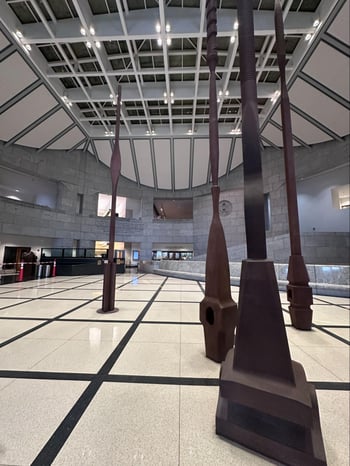 At another courthouse I assessed, Beverly Pepper’s Sentinels of Justice display sculptural strength while reinforcing themes of society’s accomplishments.
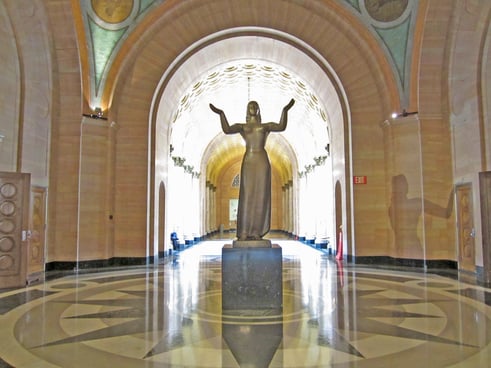 The color and artwork greatly changes the tone of the space it is within, above we can see Lady Justice at a courthouse welcoming visitors (read more here).
These works do more than beautify, they create connection. They soften the experience of entering a courthouse.
Architecture shapes public perception. When a courthouse incorporates curated public art such as murals, sculptures, digital media, or rotating exhibitions, it signals openness and humanity. Public engagement and enrichment can begin early in the planning process, linking civic education to a culturally enriched environment and deepening community connection to the meaning of public institutions.
Promoting Art Education and Engagement
Courthouses are uniquely positioned to partner with schools, universities, and local arts organizations. Public buildings can host:
• Student exhibitions in lobby spaces
• Artist-in-residence programs
• Public lectures connecting art, justice, and architecture
• Workshops that explore civic systems through creative expression
These initiatives transform underutilized public areas into active civic classrooms. Generous lobbies, jury assembly areas, and waiting spaces can support rotating exhibitions without disrupting daily court operations. Many state and local courthouses have programs and initiatives pairing courthouses with local youth and artists.
In this way, the courthouse becomes more than a judicial facility — it becomes a platform for civic literacy and connection.
Supporting Local Artists and Creative Economies
Commissioning artists for permanent and temporary installations invests directly in the regional creative economy. The U.S. General Services Administration (GSA) administers the Art in Architecture Program, established in 1972, which allocates a portion of federal building construction budgets for site-specific, permanently installed artworks (follow link here). The program commissions contemporary American artists to create works that are integrated into the architecture of new federal buildings, including courthouses, ensuring that public art is considered part of the building’s civic identity rather than an afterthought.
While the federal GSA Art in Architecture Program allocates roughly ½% of construction costs for permanent art, many states and municipalities have their own percent-for-art laws that range from about 0.5% to 1.5% (or discretionary depending on the jurisdiction) for public buildings.
When artists are engaged early in the design process, art can be embedded into:
• Façade systems
• Structural elements
• Atrium volumes
• Integrated lighting features
• Landscape and plaza design
To be successful, art must be considered during programming and schematic design. Early planning must account for structural, mechanical, electrical, plumbing (MEP) and life safety coordination, with appropriate space and budget allocated so art is integrated into the building’s infrastructure rather than treated as an afterthought.
This collaborative approach strengthens both the architectural expression and the cultural fabric of the city.
Designing the Balance: Security, Transparency, and Technical Integration
While the civic and cultural benefits are compelling, implementation must be technically rigorous. Courthouses operate under strict security protocols, and art integration must support, not compromise, those requirements.
The foundational principle is clear zoning between public and private spaces.
Interior art installations should be located behind security screening but within public circulation zones- including lobbies, halls, jury assembly areas, and waiting spaces. They should not be placed in restricted office areas, secure staff corridors, or protected circulation paths.
This approach:
• Maintains separation between public and restricted areas
• Protects artwork from vandalism
• Preserves operational integrity
• Allows controlled public access
When art is located on the exterior of the courthouse, it also must comply with security design requirements, including maintaining required standoff distances, preserving clear sight lines to entrances and perimeter zones, and avoiding features that could conceal suspicious items or provide climbing access to secure areas. Materials, anchoring systems, and placement should also be designed to resist tampering, vandalism, and blast effects while ensuring the artwork does not interfere with surveillance, lighting, or vehicle barrier systems.
Extending the Civic Life Through Transparency and Activation
Courthouses often occupy prominent downtown sites, generating significant daytime foot traffic but limited evening activity. Curated exhibitions and public programs can extend activity beyond traditional court hours. In a previous post, I discussed how portions of courthouses can be used as event spaces. When strategically planned, public lobbies, plazas, and assembly spaces can support exhibitions, educational programming, community events, and rentable civic gatherings—extending activity beyond traditional court hours.
Modern courthouse design should prioritize ground-floor transparency and active public spaces that:
• Increase pedestrian presence and natural surveillance
• Support adjacent retail and cultural uses
• Reinforce the courthouse as a civic anchor
• Feature generous, daylit lobbies with clear façades that reveal interior civic life
• Incorporate well-lit evening art displays to create safe surroundings
When curated art inhabits these visible public volumes, the courthouse operates as an urban gallery—activating the streetscape while maintaining security through appropriate setbacks, integrated perimeter protections, and Crime Prevention Through Environmental Design (CPTED) informed design strategies.
A Deliberate Balancing Act
Modern courthouses have the opportunity to be more than judicial facilities — they can become civic anchors that encourage community engagement, education, and downtown vitality. By integrating curated art programs and creating transparent, active public spaces at the ground level, courthouse design can feel open, accessible, and connected to daily civic life.
When architecture and cultural programming are thoughtfully aligned, courthouses evolve into welcoming, vibrant institutions that reflect the communities they serve and contribute meaningfully to the public realm.
When art is embedded in the architecture, it elevates the visitor experience, strengthens community connection, and reinforces the courthouse as a true civic anchor. With careful design and planning, art does not compromise the courthouse — it enhances it.
Get your copy of the Fundamentals of Courthouse Design
.jpg?width=352&name=AI%20Court%20(blog).jpg)
.jpg?width=352&name=Modern%20Cou%20(blog).jpg)