
.jpg)
As cities and towns look for smarter ways to upgrade public services without overspending, combined police and fire stations are getting more attention. On the surface, the idea is simple: put related emergency services together under one roof. But once you look closer, it becomes clear that these buildings offer real advantages. And some very real design challenges, too.
What Is a Combined Fire and Police Station?
A combined public safety building brings police and fire/rescue services together in one facility. That does not mean the two departments suddenly operate as one unit. They still need separate primary spaces for their distinct day-to-day functions. But they can share selected support areas like parking, training rooms, meeting spaces, and some building systems. The idea is to improve coordination, make better use of resources, and create a more efficient public safety building overall.
Why Do Communities Like This Idea?
There are usually three big reasons communities are drawn to combined stations.
First, police and fire departments already work side by side on many of the same calls. Putting them in the same building can make everyday communication easier, help build trust between departments, and support faster teamwork when emergencies happen.
Second, a combined station can be a practical way to save space and avoid unnecessary duplication. Shared functions in the building might include:
- Parking
- Training rooms
- Conference spaces
- Fitness areas
- Community meeting spaces
- Storage
- Building systems such as mechanical equipment or emergency power.
When those support spaces are planned well, communities can use their budgets more efficiently without compromising the core operational needs of either department.
Third, a combined station can do more than function well. It can also serve the community in a visible way. Public-facing spaces like a community room can support meetings, outreach, and neighborhood events, while the building itself can become a recognizable civic landmark that helps build trust and local identity.
A Sample Layout
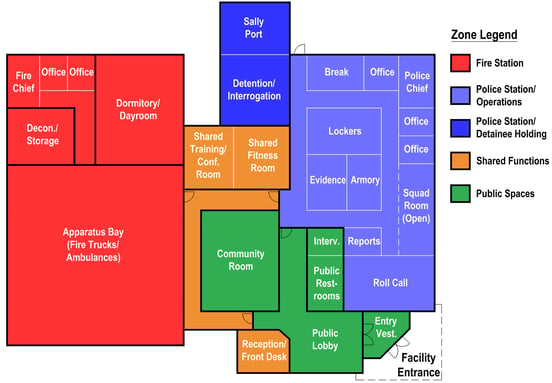
The drawing below is a basic schematic of what a combined police and fire building might look like, showing very general space blocking and relationships of the various spaces. In a real project, actual room sizes, program requirements, and support spaces would vary according to the mission, staffing, and operational needs of each community.
 The Challenges of Co-Locating Fire and Police Stations
Bringing police and fire services together in one building can create real operational and civic benefits, and it can save money too. But the design challenge is much bigger than just putting two departments under one roof. The challenge becomes how to design a building that handles very different patterns of movement, security, and access while still working as one coherent public facility.
Managing security, separating public and restricted circulation, and still supporting the operational needs of each user is often the most complicated, and most underestimated, part of a combined station. You are not just designing a building; you are combining very different risk profiles in one place.
Most of these circulation and security issues come from the fact that each part of the building works differently. Looking at the project by zone makes the challenge easier to understand.
Fire Station Zone
The fire station side is all about openness and speed. Firefighters need a direct path from living spaces and dayrooms to the gear-up area and apparatus bay, with as few obstacles as possible. When seconds count, circulation has to be simple, fast, and efficient. These spaces also tend to be strongly team-oriented, so the layout needs to support that culture, too.
Police Station Zone
The police side works very differently. Its circulation is about control, containment, and separation. The layout has to support confidential work, strict access control, and the protection of sensitive files and evidence.
On top of that, detainees in holding cells must remain fully separated from the rest of the station’s operations, which adds another layer of complexity to the plan.
Shared Zone
Shared functions work best when they have their own clearly defined zone, one that both departments can access without disrupting the secure areas of either side.
Public Zone
But there is also one more layer of circulation that needs to be considered: the public. The civic facing part of a public safety building, such as citizens using the community room making inquires at the front desk, should be be freely accessible, but those functions must be separated from the more restricted functions.
This layering of circulation and security by not only providing separate zones, but also providing the proper interconnection of those zones, needs to be part of the building design from the start. It’s not enough to lay out the space and provide door locks to keep people out. The layered security of a public safety building is part of a holistic building design.
The Balance That Makes It Work
Combined fire and police stations offer a more integrated approach to civic infrastructure by bringing emergency services together in a single facility. When designed well, they can improve coordination between departments, support faster response, and create a stronger public presence within the community. Shared spaces can also reduce unnecessary duplication and make better use of limited public funding.
But success depends on more than simply placing both departments in the same building. The design must carefully balance shared and separate spaces while supporting the very different operational needs of police and fire personnel. Security, circulation, and access control all need to be considered early in the planning process so the building functions safely and efficiently from day one.
In the end, the most successful combined public safety buildings recognize that efficiency and security must work together. When both priorities are integrated into the design from the beginning, the result is a facility that supports first responders while also serving the community in a safe, functional, and lasting way.
Get your copy of the Fundamentals of Courthouse Design
.jpg?width=352&name=prepare%20(blog).jpg)
.jpg?width=352&name=Service%20Dogs%20(blog).jpg)