.jpg)
One of the most important questions in courthouse planning is also one of the most difficult to answer:
How many courtrooms should a courthouse contain?
For decades, the answer seemed straightforward. If a court had ten judges, planners typically allocated ten courtrooms. Each judge received a dedicated courtroom and chambers suite, and courthouse planning standards were largely built around that assumption.
Today, courts operate differently than they did when many of those standards were established. Electronic filing, digital records, diversion programs, and virtual proceedings have changed how justice is delivered. At the same time, construction costs continue to rise, making it increasingly important to ensure that new courthouses are appropriately sized.
The result is a question that many jurisdictions are now confronting: should courtroom inventories be driven by the number of judges, or by actual courtroom demand?
The answer is rarely absolute. Instead, courtroom planning exists along a continuum between maximizing operational flexibility and maximizing space efficiency.
A Continuum of Competing Priorities
Courts and counties often approach courtroom planning from different perspectives.
Judges and court staff are focused on operations. They want facilities that provide flexibility, simplify scheduling, and support effective case management. Counties are responsible for funding construction, maintenance, utilities, and future capital improvements. As a result, they are often focused on reducing building size and controlling long-term costs.
Neither perspective is wrong. The challenge is finding the right balance between operational performance and fiscal responsibility.
Courtroom Alignment Continuum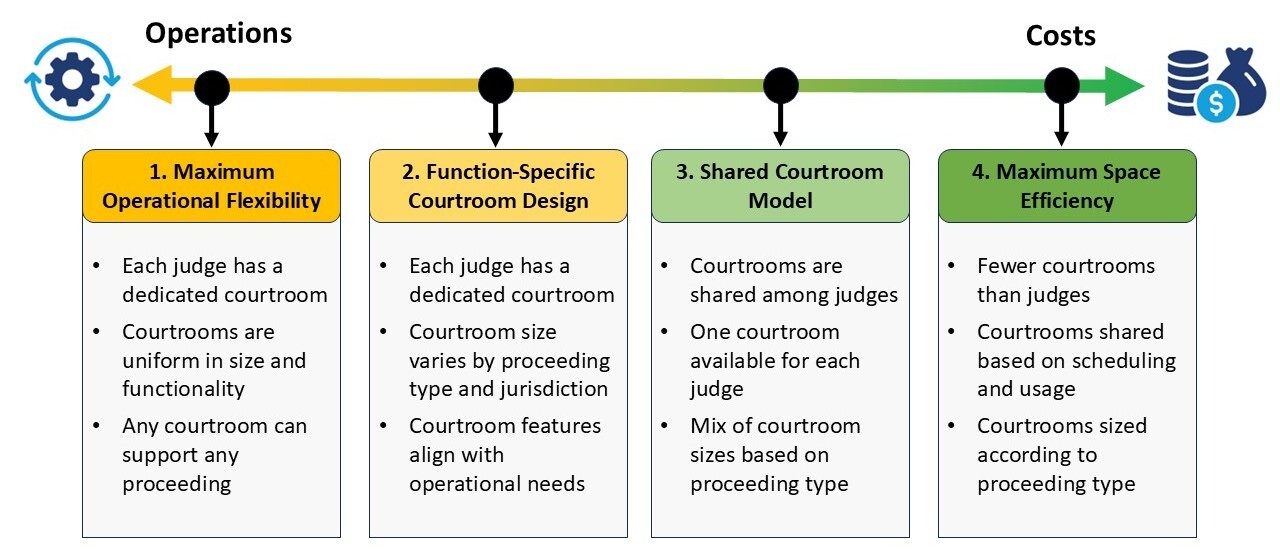
The continuum generally includes four planning approaches as shown in the figure above, ranging from maximum operational flexibility to maximum space efficiency.
Option 1: Maximum Operational Flexibility
Under this model, every judge has a dedicated courtroom, and all courtrooms are designed with similar size and functionality. Any courtroom can accommodate any proceeding, from criminal and civil trials to family and specialty matters. In theory, this provides the highest level of operational flexibility because courtroom assignments can easily adapt to changing workloads and scheduling demands.
In practice, however, this approach is uncommon. In planning more than 1,200 courthouses, I have rarely encountered it outside of smaller facilities serving a single court jurisdiction. One notable exception was a study for a large court system that prioritized speedy case disposition. The study found that a fully standardized courtroom inventory could provide the highest level of efficiency when paired with an effective scheduling system. Ultimately, the court adopted a hybrid approach, combining larger and smaller courtrooms that aligned with the needs of its two court jurisdictions.
Even though few courts fully embrace this model, it highlights the benefits of maximum flexibility. Judges have permanent courtroom assignments, scheduling is straightforward, and unexpected trials can be accommodated more easily. Because all courtrooms are designed with the same size and functionality, changes in judicial assignments or jurisdictional responsibilities can be absorbed with minimal disruption. For example, if a judge who typically presides in a non jury jurisdiction is reassigned to a court that requires jury trials, an appropriate courtroom is already available. The court does not need to reconfigure space or reassign courtrooms, which provides a high degree of operational flexibility across the entire courthouse.
The tradeoff is cost. A theoretical courthouse with ten judges and ten identical courtrooms might require approximately 200,000 gross square feet (GSF). At $900 per GSF (representing a national average project cost based on our experience), project costs would total roughly $180 million, with annual operating costs of approximately $5 million at $25 per GSF (see figure below).
The larger footprint reflects the need to equip every courtroom for every type of proceeding. Jury facilities, attorney conference rooms, storage areas, circulation space, and security infrastructure are replicated for each courtroom.
Option 2: Function-Specific Courtroom Design
This model remains the most common approach in courthouse planning today.
Each judge still has a dedicated courtroom, but the size and features of each room are tailored to the proceedings conducted there. Criminal courtrooms are typically larger and include jury facilities to support trials, while family and juvenile courtrooms can be smaller because they generally attract fewer spectators and do not require jury accommodations.
The result is a courthouse that better aligns space with operational needs.
A theoretical courthouse under this model might require approximately 190,000 GSF. Construction costs would decrease to roughly $171 million, while annual operating costs would decline to approximately $4.75 million (see figure below).
The savings come from right-sizing rather than reducing the number of courtrooms. Smaller courtrooms, reduced jury facilities, smaller public galleries, and more efficient support spaces all contribute to the reduction.
Why Most Courts Prefer This Approach
Most courts gravitate toward function-specific courtroom design because it aligns with how courts have traditionally operated. Judges have dedicated courtrooms that are appropriately sized for their jurisdiction. The courtroom is available whenever proceedings arise unexpectedly or run longer than anticipated. Judges also avoid spending significant time coordinating courtroom schedules with their peers.
Dedicated courtrooms reinforce established judicial practices and provide a consistent working environment for judges, court staff, attorneys, and security personnel. Most courthouse design standards have historically been organized around the concept of pairing judges with dedicated courtrooms and adjacent chambers. As a result, many court processes, staffing models, and operational expectations are built around this approach.
For these reasons, Option 2 has become the prevailing courthouse planning model in many jurisdictions. It reflects longstanding court culture and operational preferences while providing courtrooms appropriately sized for the work performed in each jurisdiction.
Option 3: Shared Courtroom Model
The next step along the continuum represents a significant operational shift.
The courthouse still contains ten courtrooms, but those courtrooms are shared among judges rather than assigned permanently to individuals.
Courtrooms remain specialized by function, but scheduling determines who uses each room.
A theoretical courthouse under this model might require approximately 180,000 GSF. Construction costs decrease to roughly $162 million, while annual operating costs fall to approximately $4.5 million (see figure below).
The savings come from reducing duplication. Shared attorney conference rooms, shared waiting areas, more efficient chambers layouts, and consolidated support spaces allow the building to become more compact.
What Prevents Courts from Moving to This Model?
The strongest predictor of courtroom sharing is not technology or budget. It is court culture.
Many judges view dedicated courtrooms as essential to efficient operations. Court staff assignments are often built around permanent courtroom ownership. Security procedures and daily workflows may also depend on dedicated spaces.
Moving toward shared courtroom operations requires advanced scheduling systems, greater coordination among judges, and a willingness to rethink long-standing operational practices.
For many courts, these cultural changes are more difficult than the physical building changes.
Option 4: Maximum Space Efficiency
At the far end of the continuum, the courthouse contains fewer courtrooms than judges.
Courtrooms are shared extensively and scheduling becomes a critical operational function.
A theoretical courthouse with ten judges and eight courtrooms might require approximately 165,000 GSF. Construction costs would fall to approximately $148.5 million and annual operating costs would decline to about $4.13 million (see figure below).
The savings come from eliminating entire courtroom suites and the support spaces associated with them. Reducing courtroom counts also reduces circulation, jury facilities, holding areas, technology infrastructure, and building systems.
The reduction of two courtrooms in this example lowers construction costs by more than $22.5 million and reduces annual operating costs by nearly $620,000 compared to the traditional courtroom model (Option 2 on the continuum figure below).
The tradeoff is a greater reliance on scheduling coordination and reduced operational flexibility during peak periods.
The following figure summarizes the characteristics and cost changes for courthouses constructed with different priorities along the continuum.
Example Courthouse Costs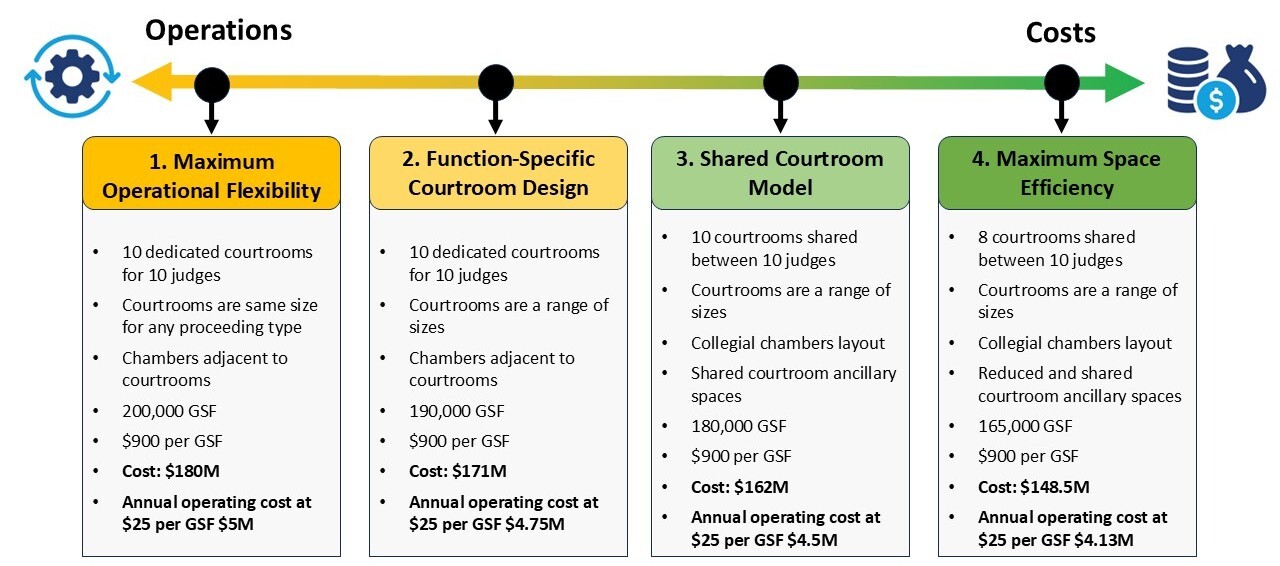
A Framework for Better Conversations
Courtrooms are the primary driver of courthouse size and cost.
A courtroom is often a multi-million-dollar investment. For that reason, courtroom planning should be driven by utilization data whenever possible.
The value of the courtroom allocation continuum is not that it identifies a single correct answer.
Instead, it provides a framework for discussing tradeoffs.
Courts can clearly articulate the operational benefits associated with dedicated courtrooms. Counties can better understand the cost implications of those decisions. Both parties can evaluate how scheduling practices, technology, staffing models, and courtroom utilization influence future facility needs.
Rather than arguing over whether there are too many or too few courtrooms, stakeholders can focus on a more productive question:
Where should the jurisdiction position itself along the continuum between operational flexibility and space efficiency?
Final Thoughts
Every courtroom is a forecast.
The courtroom decisions made today will influence courthouse size, operating costs, maintenance expenses, and service delivery for decades to come.
The goal is not to reduce courtrooms simply to save money. The goal is to make informed decisions about how justice will be delivered in the future and to align courthouse investments with that vision.
The most successful courthouse projects are not necessarily the largest or the least expensive. They are the projects that achieve the right balance between operational performance, fiscal responsibility, and long-term adaptability.
___________________________________________________________________________________________________________________

Get your copy of the Fundamentals of Courthouse Design
.jpg?width=352&name=closed%20courtroom%20(blog).jpg)