.jpg)
Before anyone speaks in a courtroom, the building has already said something.
From the height of the ceiling to the absence of daylight in the waiting area, every architectural decision shapes how people feel the moment they enter the space.
Courthouses are designed to communicate authority, permanence, and civic importance. But they are also environments where people are asked to perform under extraordinary pressure. Judges make life-altering decisions. Jurors absorb emotionally difficult testimony. Court staff maintain accuracy and composure through an endless procession of cases.
Despite these intense cognitive and emotional demands, courthouse design has historically focused more on symbolism than human performance. That stands in contrast to other high-stakes environments. Hospitals, airports, and control rooms are routinely designed around research on stress, cognition, fatigue, and communication. Lighting, acoustics, circulation, and spatial organization are treated as operational tools because performance outcomes depend on them.
The courthouse is no different. Increasingly, research suggests those conditions matter more than we once assumed.
The Courthouse as a Performance Environment
Every courthouse participant experiences the building differently, but all rely on the environment to support quality performance and decision-making.
Judges must sustain attention across hours of testimony and multiple cases in a single day. Research on judicial decision-making has shown that factors unrelated to case complexity, including fatigue and cognitive depletion, can influence outcomes. While architecture cannot eliminate those pressures, it can either compound them or help mitigate them. Access to daylight, acoustic control, ergonomic support, and moments of visual relief all influence a person’s ability to remain focused over time.
Jurors are among the most environmentally disadvantaged participants to enter the courthouse. They arrive as members of the general public, unfamiliar with the space, and are asked to absorb dense and often emotionally difficult information. Comfortable seating, adequate space to move around, proper temperature control, and accessible restroom facilities are functional requirements for a group of people who may spend hours or days in a stressful environment. The jury deliberation room also needs to support cognitive recovery between courtroom sessions. Biophilic design principles emphasize that access to natural light and natural elements meaningfully lowers cortisol and supports cognitive restoration.
Witnesses must accurately recall and communicate personal experiences. At times, they must do this in front of a large crowd and the press. Neuroscience research consistently shows that stress interferes with memory retrieval and communication. The spatial arrangement of a courtroom plays a direct role in how much stress a witness experiences on the stand. How close is opposing counsel? Is the sightline dominated by unfamiliar and potentially threatening figures? Is the microphone positioned naturally, or does using it feel awkward and performative?
Attorneys are communicators, and communication is deeply environment-dependent. Acoustic conditions affect whether a voice carries clearly across the room. The spatial relationship between where an attorney stands and where jurors sit during trial shapes the psychological connection between them. An attorney working against a poorly designed space is spending energy compensating for the environment rather than focusing on the case itself.
Court staff experience these conditions every day. Clerks, bailiffs, reporters, and administrative personnel operate in environments that demand constant accuracy and consistency. Research across workplace design has repeatedly linked poor environmental conditions to fatigue, burnout, and increased errors. In a system built on precision and reliability, it is imperative that the building supports quality performance.
What the Research Reveals
Architecture shapes perceived fairness before a word is spoken. A study comparing two Italian courthouses asked participants to imagine attending the trial of a wrongly accused friend in each building. One was a small, converted medieval convent and the other a large, modern courthouse built in the 1990s. Participants perceived the massive-scale architecture as more threatening, and estimated a higher probability that their friend would be convicted in the newer courthouse. That sense of threat had a measurable effect on how participants expected justice to unfold.
Spatial intimidation changes perception. The physical layout of a courtroom communicates unspoken meaning. For instance, who is elevated, who faces whom, and how are people positioned in respect to one another? These cues affect how participants interpret the fairness of the process itself. Layouts designed around those principles create better conditions for participants to do their jobs well.
Sensory design affects cognition. Court proceedings can last hours and place real demands on everyone's ability to stay focused and alert. Workplaces that use daylight-mimicking light consistently show improvements in alertness and reductions in mental fatigue over the course of a day compared to standard artificial light. Additionally, poor acoustics interfere with how testimony is heard, interpreted, and remembered. In a setting where attention and judgement are critical, sensory design becomes more than an aesthetic consideration.
Cognitive load is a finite resource, and poor design depletes it. Every time a person has to interpret confusing signage, navigate an unclear layout, and even manage physical discomfort from poor seating, they are spending mental resources. Those are resources no longer available for the actual task of following legal arguments or making sound decisions. Design that creates friction taxes human cognitive capacity to ensure justice is fair.
Design Through a Human Performance Lens
Several principles emerge from a human-centered design that are not always front and center in courthouse planning conversations.
- Legible wayfinding. When a building is “legible,” meaning people can navigate it without effort or confusion, they arrive at the courtroom with their mental resources intact. Every moment spent trying to find the right room, the right elevator, the right door is a small but real tax on cognitive capacity. Clear wayfinding throughout the building is functionally important to what happens inside the courtroom.
Practical wayfinding strategies begin with organizing spaces in a logical sequence that reflects how visitors move through the courthouse. Public destinations should be easy to locate, with clear sightlines, consistent signage, prominent courtroom identification, and information kiosks positioned at key decision points. Distinctive architectural features, natural light, and recognizable landmarks can further help visitors orient themselves and navigate the building with confidence. - Courtroom spatial arrangements. The physical relationships between participants communicate meaning about status, threat, and fairness. These arrangements shape behavior. Courtroom layouts that reflect the principles of procedural fairness, rather than simply inherited tradition, create better conditions for all participants to perform their roles as intended.
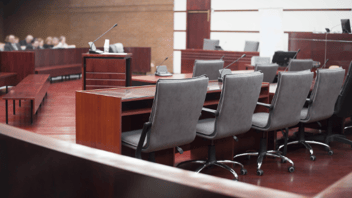
In practice, this requires careful attention to the placement and separation of key courtroom functions. The well area should provide sufficient space for judges, attorneys, court staff, and litigants to move safely and efficiently between their respective duty stations without creating congestion or distractions. Defendant tables should be positioned to avoid unnecessary proximity to the witness stand or jury box, reducing opportunities for intimidation or perceived influence. Attorney tables should also be arranged to allow private conversations between counsel and clients without being overheard by jurors, witnesses, or spectators. Combined with clear sightlines to the bench and witness stand, these spatial relationships help support courtroom security, preserve the integrity of proceedings, and reinforce perceptions of fairness. - Separation of circulation paths. Although typically framed as a security consideration, path separation also serves a performance function. The stress of encountering an opposing party in a corridor immediately before testimony is a cognitive and emotional disruption. Thoughtful separation of public, secure, and staff circulation is just as important for protecting the mental state of participants at the moments it matters most.
In practice, courthouses should be organized around three distinct circulation systems: public, restricted staff, and secure circulation for judges, jurors, and in custody defendants. These circulation zones should remain separate throughout the facility and only meet within the courtroom itself. Similar principles should extend beyond the courtroom floors. Clerk offices, probation departments, and other court related offices should clearly distinguish public service areas from employee workspaces through controlled access points and secured corridors. This separation reduces unnecessary interruptions, improves operational efficiency, enhances security, and helps ensure that court participants interact only in appropriate settings and under appropriate conditions. - Environmental consistency. Performance is affected by cumulative environmental conditions. This includes in the parking area, the lobby, the security line, even the condition of the restrooms. A courthouse that is comfortable to wait in and easy to navigate throughout the entire journey reduces cumulative stress and supports better experiences overall.
In practice, this means maintaining a consistent level of quality, comfort, and clarity throughout the facility rather than concentrating resources only in highly visible spaces such as courtrooms and public lobbies. Comfortable waiting areas, adequate lighting, clear signage, clean restrooms, and well maintained public spaces all contribute to a more predictable and less stressful experience. When every part of the courthouse supports the same standard of care and professionalism, visitors are more likely to perceive the institution as organized, fair, and trustworthy.
Beyond Symbolism
Much of the conversation about courthouse design focuses on whether the space functions properly. But there is a second question worth asking: does this space enable the people inside it to perform their best?
A courthouse can meet functional requirements and still create unnecessary cognitive strain. When the stakes involve judgment, memory, communication, and public trust, those environmental pressures matter.
The encouraging reality is that many of the same design principles that support well-being also support better outcomes: natural light, acoustic clarity, intuitive navigation, and human-scaled spaces. These are not aesthetic extras, but part of creating environments that allow justice to function as intended.

Get your copy of the Fundamentals of Courthouse Design
.jpg?width=352&name=high%20profile%20(blog).jpg)