.jpg)
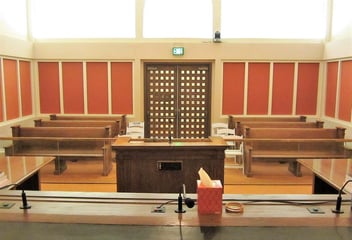
Several years ago, I was interviewing court stakeholders as part of a courthouse planning study. A judge mentioned that an interesting trial was scheduled to begin in her courtroom the following morning. I told her I would return to observe it.
When I arrived the next day, there were only a few court employees in the room. The case had settled the evening before.
If I had measured utilization only by what I observed that morning, I would have recorded an empty courtroom. But that would have missed the most important part of the story. The scheduled trial—and the certainty that a courtroom was available to conduct it—helped bring the parties to a resolution.
The courtroom had served a valuable purpose even though the trial never began.
Utilization Measures Something Important, but Not Everything
Courtroom utilization is an important part of courthouse planning. Courts should understand how often courtrooms are used for proceedings, how long those proceedings last, and whether courtroom scheduling and sharing practices can be improved.
However, utilization is easy to misunderstand.
The Courtroom Begins Working When the Trial Is Scheduled
A courtroom’s operational value often begins well before anyone enters it.
When a trial is placed on the calendar, the court makes a commitment. The judge, courtroom staff, attorneys, witnesses, security personnel, interpreters, and jurors may all need to be available. Most importantly, the parties know the case is moving toward a real decision point.
That approaching date creates an incentive to resolve the case.
In criminal matters, defendants and prosecutors may reach a plea agreement. In civil matters, the parties may negotiate a settlement. These resolutions save taxpayers time and money by avoiding the public expense of a full trial. They also reduce costs for the parties and allow judges, court employees, attorneys, law enforcement personnel, and other justice partners to turn their attention to other cases.
This efficiency depends on the court having the capacity to conduct the trial if negotiations fail. A trial date carries less weight if the parties do not believe that a courtroom will actually be available.
Some cases settle weeks in advance. Others settle the night before trial, in the courthouse, or after jury selection has begun. Courts cannot reliably predict which matters will proceed and which will resolve at the last moment. They must reserve enough capacity for the cases that do go forward.
When a scheduled trial settles, the resulting empty courtroom may look like unused space. Operationally, however, its availability helped produce the resolution.
In that sense, the courtroom was working even though the lights were off.
Courts Need Capacity for Uncertainty
Courtroom planning cannot be based on perfect scheduling because litigation is not perfectly predictable.
A hearing may take 20 minutes or several hours. A trial expected to last three days may last a week. A defendant may accept a plea agreement, or negotiations may collapse. A witness may become unavailable. A judge may need to address an emergency matter.
This variability creates a need for operational capacity: enough space to keep the court functioning when actual events differ from the schedule.
One hundred percent courtroom occupancy would not represent perfect efficiency. It would likely indicate that the court has little ability to accommodate delays, emergencies, extended trials, visiting judges, or cases that unexpectedly proceed rather than settle.
The objective should be appropriate utilization, not continuous occupancy.
Readiness Is Also a Form of Use
A fire station is not unnecessary when its vehicles are not responding to a call. An emergency operations center does not lack value because no disaster is underway. An airport runway is not underperforming simply because an aircraft is not taking off or landing at every moment. Each provides capacity for events that are important, variable, and sometimes difficult to predict. Part of its value lies in being ready when needed.
Courtrooms operate on the same broad principle, although they are not identical to these other facilities. They are sometimes compared with operating rooms: if surgeons can share specialized space, why can’t judges? But an operation is a coordinated procedure managed largely within one institution. A trial is the culmination of a less predictable process involving attorneys, parties, jurors, witnesses, interpreters, law enforcement, and court staff, all with separate schedules and requirements. Courtroom sharing may be appropriate, but it must preserve the capacity and certainty needed to bring these participants together and conduct the trial if the case does not settle.
Courts have scheduled calendars, established procedures, and generally predictable operating hours. Still, whether a case will proceed, how long it will take, and what resources it will require can remain uncertain until the last moment. Readiness should not excuse persistently low courtroom utilization without further analysis. It should, however, be recognized as a legitimate operational function.
Courtrooms Support More Than Proceedings
Courtrooms are among the largest and most symbolically important public spaces in a courthouse. Their seating, technology, acoustics, security, and formal setting make them useful for activities beyond trials and hearings.
Depending on the court and facility, courtrooms may host:
- Judicial investitures, retirements, and memorial ceremonies
- Employee recognition and service awards
- Programs honoring attorneys, judges, justice partners, and community members
- Attorney admission and swearing-in ceremonies
- Naturalization ceremonies
- Mock trials and student competitions
- Law Day and Constitution Day programs
- School visits and civic education
- Continuing legal education
- Judicial and court staff training
- Bar association meetings and bench-bar programs
- Meetings with justice-system partners
- Public presentations and community outreach
- All-staff meetings and emergency briefings
- Press briefings related to high-profile cases
These activities may not appear in conventional courtroom utilization statistics, but they support the court’s institutional and public mission. The dignity and symbolism of the courtroom make it an appropriate setting for recognizing public service, welcoming new citizens, educating students, and marking important milestones.
In space-constrained courthouses, courtrooms may serve an even broader purpose. They are often used for meetings because adequate conference space does not exist. They may provide overflow seating, jury assembly accommodations, training space, or a place to gather employees during major events.
These secondary functions do not automatically justify every courtroom. However, they should be documented and understood before a courtroom is labeled unnecessary.
What a Complete Utilization Study Should Measure
Proceeding hours should remain a central measure. They provide the best evidence of how frequently a courtroom is used for its primary purpose. But they should be considered alongside several additional factors.
Actual proceeding use. How often was the courtroom occupied for trials, hearings, motions, arraignments, and other judicial proceedings?
Scheduled use. How many proceedings and trials were placed on the calendar, including those that settled, resolved, or were continued before the courtroom was physically occupied?
Timing and reason for cancellations. Did a trial settle weeks in advance or on the morning it was scheduled? The timing determines whether the court had a realistic opportunity to reassign the room.
Non-proceeding use. How often was the courtroom used for ceremonies, meetings, jury functions, training, or community programs?
Peak and temporary demand. When are courtrooms most heavily used, and how often do visiting or rotating judges require space? Annual averages can conceal concentrated morning schedules, trial periods, or other temporary needs.
Proceeding duration and variability. How predictable are the court’s cases? Complex criminal, civil, family, or high-security matters may require extended and uncertain blocks of time.
Sharing feasibility. Can a courtroom be shared without disrupting judicial schedules, court operations, security, technology, evidence handling, or the needs of jurors and litigants?
Alternative space availability. Is the courtroom hosting meetings and jury functions because the courthouse lacks appropriate space elsewhere?
Future flexibility. Can the room accommodate different proceeding types, visiting judges, changes in technology, or fluctuations in caseload?
This broader approach does not weaken utilization analysis. It makes the analysis more accurate.
From Counting Hours to Understanding Value
The question is not simply, “How many hours was the courtroom occupied?”
A more complete analysis asks:
- What work was the courtroom supporting?
- What scheduled demand was it reserved to accommodate?
- What happened to the cases scheduled there?
- How many cases settled shortly before trial?
- What temporary, visiting, or rotating judicial needs must the courthouse support?
- How much uncertainty must the court absorb?
- Could sharing or more flexible scheduling support the same functions?
- What would happen to court operations if the courtroom were removed?
Some courtrooms will prove to be underused. In those cases, sharing, reassignment, or conversion may be appropriate. Other courtrooms may have modest proceeding hours but remain necessary because of trial uncertainty, case complexity, temporary judicial demand, or the lack of suitable alternative space.
The goal should not be to defend every courtroom or reduce courtroom counts based on a single metric. It should be to understand the relationship among courtroom supply, scheduled demand, actual proceedings, case resolution, and operational flexibility.
Courtrooms play a valuable role in the administration of justice. They provide a place for proceedings, but they also create the capacity and certainty that encourage cases to resolve without trial—often saving taxpayers significant time and expense.
Utilization is an essential part of courtroom analysis. It is simply not the entire analysis.
An empty courtroom may represent excess capacity. It may also represent a case that settled, a trial that remains uncertain, or the flexibility that allows the justice system to function. Good courthouse planning must be able to tell the difference.

Get your copy of the Fundamentals of Courthouse Design
.jpg?width=352&name=Rethinking%20(blog).jpg)