
-1.jpg)
Court filings are declining in many jurisdictions. Does that mean future courthouses will need fewer courtrooms?
Not necessarily.
In my recent blog, I explored the forces behind lower filing volumes, including staffing shortages, diversion programs, demographic shifts, and changing societal trends. The larger takeaway was that fewer cases do not necessarily mean less work. Many courts are managing a smaller number of increasingly complex cases that demand more time, coordination, and resources.
For courthouse planners, the challenge is determining what declining caseloads truly mean for future courtroom needs.
From "How Many?" to "What Kind?"
For decades, courthouse planning has focused on projecting future caseloads, estimating the number of judges, and determining how many courtrooms would be needed to support them. Those factors remain important, but they no longer tell the whole story. The question is shifting from "How many courtrooms do we need?" to "What kind of courtrooms do we need?"
As courthouse planners, we've seen this firsthand. During courthouse assessments, it’s not uncommon to find courtrooms that are occupied only a few hours each week, even though the building itself is busy every day. Judges may be hearing matters in chambers, conducting remote proceedings, participating in settlement conferences, or handling administrative responsibilities rather than occupying a courtroom full time.
These observations reinforce an important point: courthouse planning should be based on how courtrooms are actually used, not simply on how many cases are filed.
Some jurisdictions may ultimately require fewer courtrooms, while others may not. In either case, the goal should be courtrooms that are flexible enough to support changing operational needs over time.
Five Principles for Planning Future Courtrooms
As courts continue to evolve, it’s our view that courthouse planning should focus on several key principles:
Plan for flexibility, not fixed assignments. Traditionally, many court jurisdictions assign courtrooms to individual judges or specific case types. While that model may still make sense in some jurisdictions, many courts can improve efficiency by creating courtrooms that support multiple judges and a variety of proceedings. Flexible scheduling and shared courtroom resources allow facilities to adapt as judicial assignments and workloads change.
Right-size facilities without limiting future options. Declining caseloads should not automatically result in fewer courtrooms. Instead, they present an opportunity to avoid overbuilding while designing facilities that can accommodate future growth or operational changes. Incorporating shell space, movable partitions, or adjacent support areas that can be converted into courtroom functions provides flexibility without significantly increasing initial construction costs.
Design around how courts operate today and in the future. Modern courtrooms must support much more than traditional in-person hearings. Hybrid proceedings, remote testimony, digital evidence presentation, language interpretation technology, specialty courts, and alternative dispute resolution all influence how courtroom space is used. Planning for these capabilities from the outset reduces the need for costly renovations later.
Measure courtroom utilization, not just caseload. Caseload filing statistics provide valuable information, but they don't tell the complete story. Understanding how often courtrooms are occupied, how long proceedings last, when peak demand occurs, and how different case types use courtroom space provides a more accurate basis for planning. Utilization studies often identify opportunities to improve scheduling and share courtrooms without compromising access to justice.
In many courthouses we've studied, the issue is not a shortage of courtrooms but the way they are assigned and scheduled. Courtrooms reserved for individual judges or specific case types may sit vacant while other court functions compete for space. Evaluating actual utilization often reveals opportunities to increase efficiency through shared courtroom scheduling rather than constructing additional courtrooms.
Create spaces that can evolve over time. The courthouse of the future should be viewed as a long-term public asset that can respond to changing needs. A courtroom may host criminal proceedings today, family court tomorrow, judicial training next month, and mediation sessions the following year. Designing adaptable spaces extends the useful life of the building, improves space utilization, and provides greater value for taxpayers over the life of the facility.
Flexibility Is the New Standard
This approach recognizes that court operations are becoming more dynamic. Hybrid proceedings, specialty dockets, changing judicial assignments, and advances in technology all require facilities that can respond to changing needs. Instead of sitting idle while waiting for a particular judge or calendar, adaptable courtrooms can support a wider range of functions and achieve higher utilization throughout the life of the building.
None of this suggests that forecasting is any less important. Reliable projections remain essential. However, filing counts alone should no longer drive courthouse planning decisions. The courthouses that serve communities best over the next 30 years will not simply have the right number of courtrooms. They will have courtrooms designed to adapt as the justice system continues to evolve.
A Matrix for Weighing Caseload Against Utilization
Caseload trends and courtroom utilization measure two different things. Filing counts indicate whether demand for court services is rising or falling. Utilization shows how often existing courtrooms are occupied. Neither measure alone determines how many courtrooms a jurisdiction needs. Considered together, however, they provide a practical starting point for planning.
The matrix below combines these two measures. Begin with the caseload trend across the top, then identify whether courtroom utilization is high or low. The point where the two conditions intersect suggests the most likely planning response.
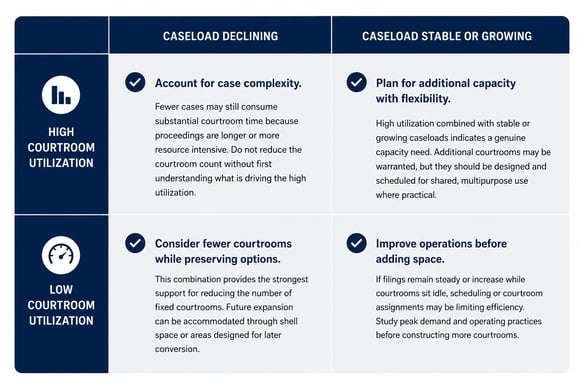
The matrix is a screening tool, not a formula. A jurisdiction with declining caseloads and high courtroom utilization, for example, should not assume that fewer filings mean fewer courtrooms are needed. The remaining cases may involve longer trials, more complex evidence, additional security, interpreters, or greater numbers of self-represented litigants. In that situation, each case may require more courtroom time than filing counts suggest.
Declining caseloads combined with low utilization provide the clearest support for fewer courtrooms. Even then, planners should confirm that the courtrooms are also underused during peak periods. A courtroom that appears lightly occupied over an entire week may still be essential when several judges need space at the same time, particularly during morning calendars.
The right-hand side of the matrix illustrates why utilization matters even when caseloads are not declining. Low utilization paired with stable or growing filings may indicate a scheduling or assignment issue rather than a need for construction. When both caseload and utilization are high, additional capacity may be justified. In larger courthouses, that growth can often be accommodated through a shared pool of standardized courtrooms rather than a dedicated courtroom for every judge.
Used this way, the matrix helps jurisdictions move beyond caseload projections alone. It provides a clearer basis for deciding whether to reduce courtroom counts, improve scheduling, preserve existing capacity, or plan for growth.
What This Means for Courthouse Planning
The matrix illustrates an important principle: no single measure should drive courthouse planning decisions. Caseload projections remain essential, but they should always be considered alongside courtroom utilization, peak demand, and the way courtrooms are actually used.
Used together, these measures help jurisdictions make more informed decisions about future courtroom needs. In some cases, they may support reducing the number of courtrooms while preserving options for future expansion. In others, they may reveal opportunities to improve scheduling, share courtrooms among judges, or create a pool of flexible, multipurpose courtrooms before investing in additional construction. Where both demand and utilization are high, additional courtroom capacity may be appropriate, but it should still emphasize adaptability rather than permanently assigning a courtroom to every judge.
Ultimately, the objective is not to build fewer courtrooms simply because filings have declined. It is to provide the right number and mix of courtrooms to meet operational needs, accommodate peak demand, and remain adaptable as court operations evolve. By evaluating both caseload trends and courtroom utilization, courthouse planners can make decisions that are more data driven, more defensible, and better positioned to serve the community for decades to come.

Get your copy of the Fundamentals of Courthouse Design
.jpg?width=352&name=Inclusive%20Courtrooms%20(blog).jpg)
.jpg?width=352&name=Rethinking%20(blog).jpg)
.jpg?width=352&name=smart%20courtroom%20(blog).jpg)