.jpg)
Courthouse planning is ultimately about people. Judges and court staff need spaces that support efficient operations. Sheriff’s offices must maintain security. Attorneys need appropriate spaces to meet with clients. Jurors and members of the public need facilities that are accessible and easy to navigate.
Understanding these different experiences is essential to good planning. Those who work in and use a courthouse provide insight into daily operations and challenges that cannot always be found in facility data or statistical analysis.
For courthouse planners, these insights begin with listening.
Meaningful Stakeholder Engagement
Meaningful stakeholder engagement helps planners understand how a courthouse actually operates. It reveals conditions that may not be apparent during a facility tour and provides context for interpreting data. Four areas are particularly important.
Engage a Broad Range of Stakeholders
No single group sees the entire courthouse operation. Judges and clerks may experience a challenge differently from sheriff’s deputies. Court administrators may recognize broader operational impacts. Attorneys and other courthouse users bring additional perspectives.
Planning sessions with these groups help identify their unique needs and concerns. They also reveal issues that cross departmental lines. Bringing these perspectives together gives planners a more complete understanding of the facility and the people it serves.
Learn from Day-to-Day Experience
Courthouse staff know how the facility functions during a busy court day. They see where operations slow down and where security or circulation problems routinely occur.
In my work as a court planner, stakeholder sessions have uncovered problems that were not immediately apparent from observing the building. A space may appear adequate until staff explain that jurors regularly cross paths with defendants’ families. Employees may need to travel through public areas to perform routine tasks. A room may serve a function it was never designed to accommodate.
Staff also develop workarounds to compensate for facility limitations. Over time, these arrangements can become part of the normal routine. Understanding them helps planners distinguish between how a courthouse appears to function and how people actually make it work.
Understand How Functions Interact
Courthouse departments do not operate independently. Their workflows and circulation patterns are connected. A decision about one function can affect operations elsewhere in the building.
I have seen this when evaluating the location of court functions within an existing facility. Relocating a department into available space may initially appear to solve a space problem. Stakeholder discussions may reveal that the move separates functions that interact throughout the day or creates new circulation and security concerns.
These conversations can also reveal opportunities. Departments that interact frequently may benefit from being closer together. Some may be able to share resources. Repositioning public-facing services may reduce unnecessary movement through the building.
Understanding these relationships allows planners to evaluate the courthouse as an interconnected system rather than a collection of individual departments.
Incorporate Stakeholder Input with Data and Analysis
Historical caseload and demographic trends provide an important quantitative foundation for planning. Staffing data, space utilization, and facility conditions add to that understanding. Stakeholders help explain the story behind the numbers.
For example, declining caseloads could suggest that workload and future space needs are decreasing. Discussions with judges and staff may reveal that cases have become more complex. Proceedings may take longer or require more participants. Technology and security requirements may also have changed. Fewer filings, therefore, may not mean less demand on the court or its facilities.
Similarly, stable staffing numbers do not necessarily mean that existing workspaces function well. Changes in courtroom utilization may reflect scheduling practices or changes in how proceedings are conducted.
Planners can test stakeholder observations against the data and facility conditions. Bringing these sources together provides a stronger basis for evaluating alternatives and making responsible long-term investments.
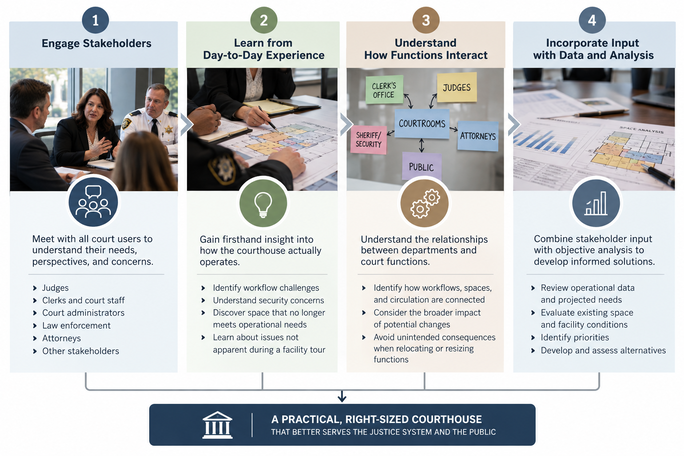
The graphic below illustrates how stakeholder engagement informs each stage of the courthouse planning process, from understanding day-to-day operations to interpreting court trends and developing data-driven solutions that better serve the justice system and the public.
Listening Creates a Stronger Foundation for Planning
Stakeholder engagement does not mean that every request becomes a recommendation. Instead, planners seek to understand the need behind the request.
A stakeholder may ask for another office, a larger courtroom, or a different departmental location. Through discussion, the planner may determine that the underlying concern involves privacy, storage, circulation, scheduling, or access to another department.
Understanding that concern gives planners more options for addressing it. It also helps balance individual needs with available resources and long-term priorities. Identifying these issues early reduces the risk of recommending space changes that leave the actual problem unresolved.
Engagement should continue as planning alternatives develop. Stakeholders can help confirm whether proposed solutions address daily operational needs and identify consequences that require further evaluation.
Effective courthouse planning combines the knowledge of the people who use the facility with objective analysis and an understanding of court operations. Together, these perspectives support practical solutions for the courthouse as a whole.
The process should not start with a floor plan. It should start with listening. Data tells us what is happening. The people closest to the work help us understand why. Together, they provide the foundation for better courthouse planning.
Get your copy of the Fundamentals of Courthouse Design