
Threats, Harassment, Warning Signs: Is Your Court Connecting the Dots?
Ask anyone who has worked in a courthouse for a few years and they can probably tell you about someone who worried them. Maybe a litigant kept calling the clerk's office after the case closed or showed up at the entrance on days he had no hearing. Maybe a judge got an email that felt a little too personal.
What they often can't tell you is what happened to that information afterward. In a lot of courts the answer is nothing. The clerk mentioned it to a coworker. The screening officer made a mental note. The judge's assistant deleted the email. Nobody ever put those pieces side by side to see that they all involved the same person.
A court can have plenty of warning signs about someone and still have no way to put it all together.
What NCSC Is Doing
The National Center for State Courts (NCSC) is taking this on through Safer Courts. The initiative is funded by the State Justice Institute. NCSC plans to develop standard tools for reporting incidents and evaluating threats. It also plans a national system to track threats and incidents involving state courts. Other goals include updated minimum standards for court security and clearer roles when state and local agencies share security duties.
NCSC's national convening in October brought together 182 people from 49 states and four territories. The discussion covered emerging threats, risk management and court security practices along with the wellbeing of judges and court staff.
Courts don't have to wait for that national system. They can start connecting their own information today.
Where Information Gets Lost
If something didn’t feel right in your courthouse today, who would you tell? When court staff give different answers or say they wouldn't report it at all, that is a gap.
That hesitation is a big part of the problem. Staff tend to wait until something feels serious before they say anything. A rude phone call or an odd comment at the intake counter rarely seems serious enough to report. Yet those small incidents are often where a pattern first shows up.
Even when concerns are reported, the information often ends up spread across several departments. Court administration, court security, and local law enforcement may each hold a piece of the puzzle without knowing what the others have. Some threats never reach court security personnel at all, especially those sent electronically or delivered to a judge's home. In other cases, a report gets filed but no one is responsible for reading it, comparing it with earlier reports, or deciding what to do next. When staff see no meaningful action in response to their reports, they are less likely to continue reporting concerns.
Judges can be part of the gap too. Some don't mention threats because they assume it comes with the job or don't want to seem rattled. That leaves security without the information it needs.
Following Written Procedures
Many courts have a written security plan or incident reporting policy. The harder question is whether anyone follows it. Over time, small shortcuts become routine and training from years ago fades. Procedures that appear effective on paper can gradually lose their effectiveness in practice. Each of those gaps makes it harder to connect the dots.
Warning Signs
People who commit targeted violence rarely just snap. Threat assessment research has shown that they tend to move through stages. They start with a grievance and move toward thinking about violence and then planning and preparing. People around them often notice something along the way. A direct threat may never come. Many attackers never say anything to their target.
That's why court staff should be encouraged to report concerning behavior along with any threats. That includes someone who can't let go of a ruling or keeps contacting the court following a case. It includes talk of getting even or of something bad happening, whether it's said at the counter or posted online. It covers repeated calls, letters, or visits with no real court business. It covers any contact with a judge's family or at a judge's home.
It also covers anyone who seems to be studying the building. Watch for people who hang around the entrance or parking lot, take photos, ask when a judge usually leaves, try staff-only doors, or ask how many officers are on duty.
Messages that grow more frequent, personal, or angry deserve attention. As does a person showing these signs who has just lost custody or received another unfavorable ruling in court.
None of these things alone means someone is dangerous. What matters is when several start to line up around the same person. You will only see that if the reports end up in the same place.
Steps Courts Can Take
Fixing this mostly takes someone who owns the problem and a routine people actually follow. A few places to start:
- Choose one person or office to receive every concern. Make sure everyone in the building knows who that is.
- Make reporting easy. A short form, phone number, or shared email address is enough. Tell staff directly that small things are worth reporting.
- Record incidents the same way every time. Note who was involved and what happened. Note when and where it happened, how contact was made, and the target. Consistent records make it possible to link one report to another.
- Set up a threat management team with court administration, court security, local law enforcement, and IT. Bring in behavioral health professionals when a situation calls for it. Meet on a regular schedule so the team is already working together when something happens.
- Check each new report against past ones. Decide what to do and assign someone to follow through.
- Ask judges and staff to also report threats that happen outside the building or online. NCSC's personal safety guide for judges and staff has practical advice on this. It covers logging and reporting threatening mail, testing duress alarms, and keeping personal information offline. It even suggests leaving your real name off reservations and food orders.
- Let people know their report was followed up on. Staff who never hear back eventually stop reporting.
The Role of Courthouse Design
The reporting process is only half of it. A courthouse's layout can make it easier or harder for staff to notice trouble and respond to it.
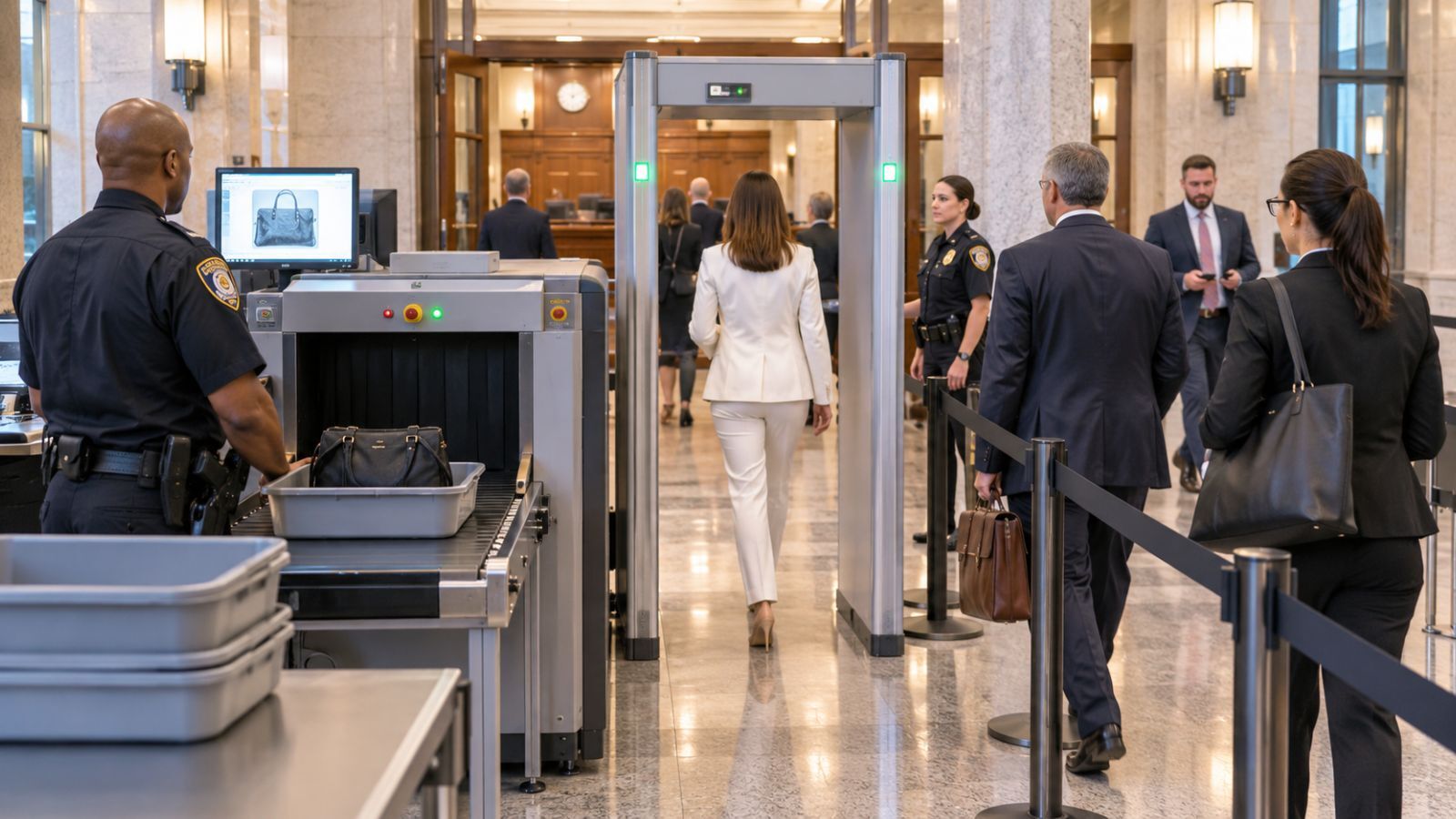
Separate circulation routes for the public, judges, staff, and in-custody individuals reduce opportunities for individuals who pose a potential threat to gain access to those they may be targeting. They also make it obvious when someone is somewhere they shouldn't be. Screening officers with a clear view of the entrance, lobby, and queue are more likely to notice someone who keeps hanging around or coming back.
Well-designed public counters with a way out for staff let clerks handle a tense exchange safely. Secure parking and a protected route to chambers matter as well because many troubling encounters happen outside the courthouse. When access control, cameras, and duress alarms are planned as one system, an alarm or unusual badge attempt ends up in the record where court security personnel can review it.
In new courthouse construction and renovation projects, incorporating security considerations early in the planning and design process is generally more cost-effective than addressing deficiencies later. For existing courthouses, a comprehensive security assessment can identify where physical design, security technology, and operational practices are not working together effectively. Ultimately, a well-designed courthouse should reinforce the court’s ability to recognize warning signs, connect information, and respond to potential threats before they escalate.
Questions to Ask Your Team
How confident are you in your court’s ability to recognize and respond to emerging threats? If a clerk received a concerning phone call today and the same individual appeared at the courthouse tomorrow, would anyone make the connection? Do judges and staff know what to report and to whom? Is someone responsible for reviewing reports, identifying patterns, and ensuring appropriate follow-up? Does your courthouse’s physical layout support these efforts?
If any of these questions are difficult to answer, a comprehensive courthouse security assessment can help identify gaps in reporting procedures, operational practices, physical security, and technology. The goal is not simply to improve how incidents are documented but to strengthen the court’s ability to connect the dots and intervene before concerning behavior escalates.
Contact us today to discuss how your court can take a more proactive and coordinated approach to courthouse security.
Get your copy of the Fundamentals of Courthouse Design
Lewis Morgan
Lewis is a computer programmer and web developer with a bachelor’s degree in computer science. He enjoys rugby, the beach, and hanging out with friends and family.
Search:
Posts by Topic:
- Courthouse Planning (204)
- Telework (82)
- Open Office Design (71)
- School Security (49)
- Courtroom Design (34)
- Courthouse Security (31)
- Hybrid Office (27)
- Workplace Security (23)
- Workspace Strategy (17)
- Courthouse Technology (16)
- Return to Work (15)
- Space Utilization (13)
- Office Manners (10)
- Police Station Design (8)
- Flexible Workspace (7)
- Mobile Workforce Solutions (7)
- Remote IT Support (6)
- Space Reduction and Utilization (6)
- Space Transition (5)
- Change Management (2)
- Space planning (2)
- Integrated Building Design (1)
- Space Programming (1)